


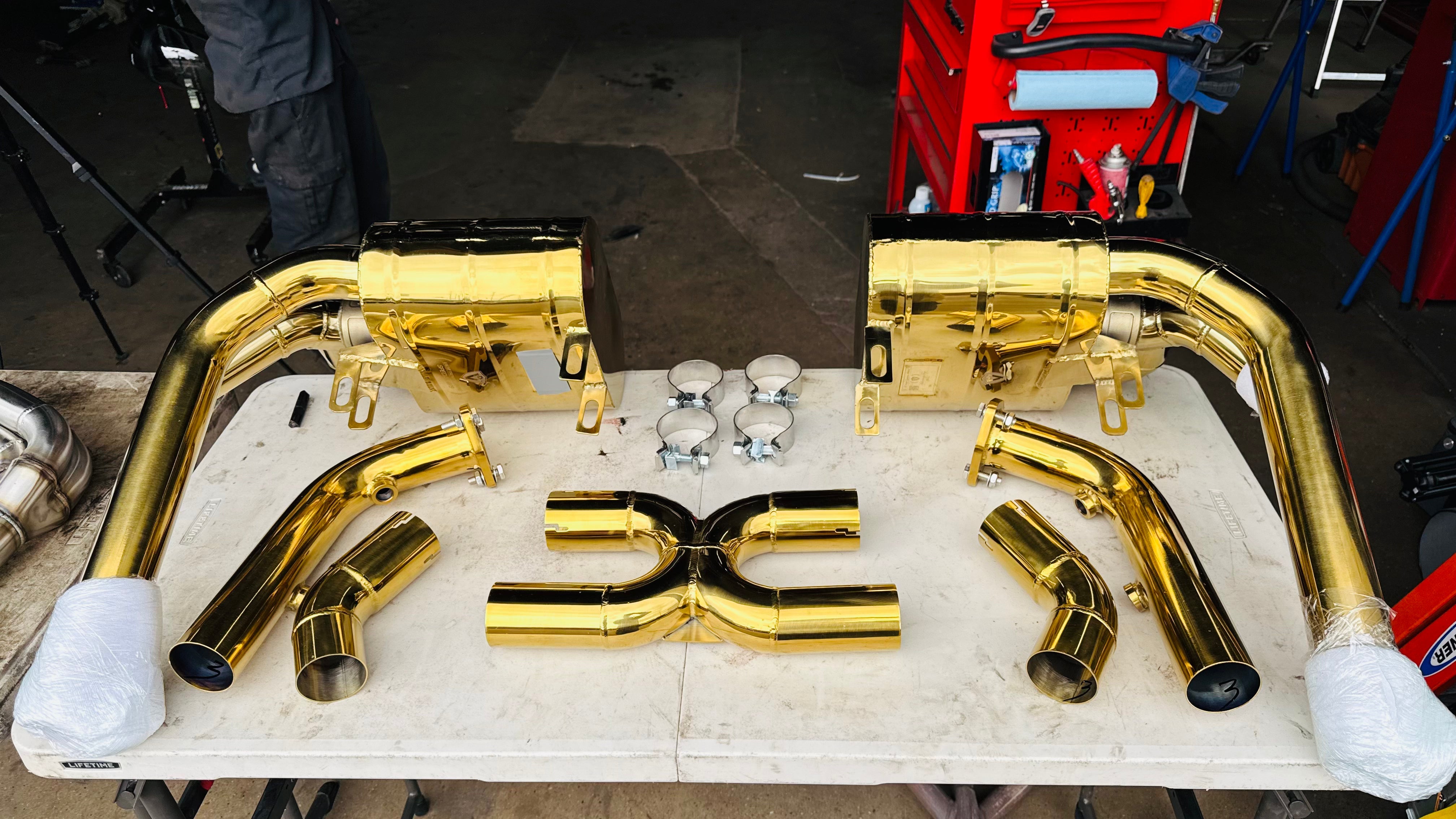
The 997.1 is quietly becoming one of the best values in air-cooled-adjacent Porsche ownership — the last of the hydraulic-steering, naturally aspirated, narrow-body 911s before the 997.2's DFI engines and the 991's electric rack. But from the factory, Porsche muzzled it. The stock exhaust on a 997.1 Carrera is heavy, restrictive, and far too polite for a flat-six that revs to 7,300 rpm.
The good news: the 997.1's exhaust architecture is modular, which means you can build it in stages — start with sound, add flow, and finish with headers — without throwing away earlier work. This guide covers the setups we actually recommend, from a weekend bolt-on to a full system, for both the Carrera (3.6 and 3.8) and the 997.1 GT3.
How the 997.1 exhaust is laid out
Before picking parts, it helps to know what you're replacing. On a 997.1 Carrera, exhaust gas flows through three stages per bank:
- Exhaust manifolds (headers) — the factory units are restrictive log-style manifolds with integrated primary cats on US cars.
- Catalytic converters / cat pipes — the mid-section between manifolds and mufflers.
- Rear silencers (mufflers) — the largest restriction and the biggest source of the stock car's muted character.
Each stage can be upgraded independently. That's why we talk about setups rather than single products — the right combination depends on how loud you want it, whether the car sees track time, and your budget.
Setup 1: Silencer section — the sound-first street setup
Best for: Daily and weekend drivers who want the flat-six voice back without drone or warranty drama.
The single highest-impact change you can make to a 997.1 Carrera is replacing the rear silencers. The Kline Innovations 997 Carrera 3.6 Silencer Section and 3.8 Silencer Section are direct OEM-fitment pieces — no cutting, no modifications, no tune required. They install in an afternoon and transform the car's character: a deeper, harder-edged note at idle, a metallic snarl above 5,000 rpm, and a tone that builds with revs instead of flattening out.
Both are available in 304 stainless steel or F1-grade Inconel 625. Stainless is the right call for most street cars (from $2,654 at time of writing). Inconel saves meaningful weight and sheds heat faster — worth it if the car tracks regularly or you simply want the best material on the car.
Running a GT3-style rear bumper on your Carrera? Kline builds a dedicated 3.6 GT3-bumper silencer and 3.8 GT3-bumper silencer with corrected tip placement for the GT3 valance — a detail most brands ignore.
What to expect: the biggest sound-per-dollar change available for the platform, modest weight savings, no check-engine lights, stock-like cabin levels at cruise.
Setup 2: Cat pipes + silencers — the complete street system
Best for: Owners who want real airflow gains and a sharper top-end, while staying street-civil.
The factory cats are the next restriction upstream. Pairing the silencer section with the Kline 997 Carrera 3.6 Cat Pipe Setor 3.8 Cat Pipe Set opens up the mid-section of the system. The result is a noticeably freer-revving engine — crisper throttle response, a louder and rawer voice, and the intake/exhaust harmonics that make the M96/M97 feel more like a Mezger.
This is the setup we'd put on most 997.1 Carreras: every part of the system behind the manifolds is optimized, but you keep factory headers, so installation stays straightforward and emissions hardware decisions stay flexible (high-flow cat options keep the car compliant — ask us about your state's requirements before ordering).
What to expect: moderate power gains in the mid-range and top-end, significantly more presence at full throttle, still livable on a morning start.
Setup 3: Full system with manifolds — maximum 997.1
Best for: Committed builds, track cars, and owners chasing every last horsepower.
The final stage is replacing the factory log manifolds with the Kline 997 Carrera 3.6 Manifolds or 3.8 Manifolds. Equal-length primaries are where real header power comes from on a flat-six — better scavenging across the rev range, a fuller mid-range, and the trademark race-car rasp that no muffler-only setup can replicate.
Combined with cat pipes and silencers, this is a complete Kline 997 Carrera system — every component engineered to work together, in stainless or Inconel throughout. Budget for a tune to take full advantage, and expect the install to be a proper shop job rather than a driveway afternoon.
What to expect: the largest power gains available from exhaust on this platform, significant total weight reduction (especially in Inconel), an unmistakable motorsport voice.
The 997.1 GT3: a different animal
The GT3's Mezger engine and factory equal-length headers mean the upgrade path looks different — the factory restriction lives in the center and side mufflers, not the manifolds.
Street setup: the SOUL Center Muffler Bypass Exhaust is the classic first move — it removes the heavy center silencer, drops real weight, and uncorks the Mezger's top-end howl while keeping the side mufflers for street manners. Available with multiple tip finishes, and in valved configurations if you want quiet-start capability.
More aggressive: add SOUL Side Muffler Bypass Pipes (also in a non-valved version) for near-race volume. The valved version is the smart pick — full send on track, tolerable on the drive there.
Headers: the GT3's factory headers are good, but SOUL Street Headers and Competition Headers unlock more, particularly above 6,000 rpm where the Mezger lives.
All of it: the SOUL Modular Competition Exhaust Package bundles the system in valved or non-valved form with your choice of tips — the one-decision option for a serious GT3 build.
Finishing touch for any 997 GT3: SOUL Bolt-On Exhaust Tips in slash-cut or straight-cut, satin, brushed, or black double-wall.
Valved vs. non-valved: which should you pick?
Valved systems give you two cars in one — quiet mode for the neighborhood and full volume on demand. They cost more and add complexity, but for a street-driven 997 they're usually worth it. Non-valved systems are lighter, simpler, and the right call for dedicated track cars or owners who never want the quiet option. If you're unsure, go valved: nobody has ever regretted having the quiet mode, plenty have regretted not having it.
Stainless steel vs. Inconel 625
304 stainless is durable, sounds excellent, and is the value pick for street cars. Inconel 625 is the material F1 teams use — roughly 30–40% lighter for the same component, with far better heat tolerance. On a track car the weight savings behind the rear axle are meaningful; on a street car it's a luxury, but a satisfying one.
FAQ
What's the best first exhaust mod for a 997.1 Carrera? The rear silencer section. It's a direct bolt-on, requires no tune, delivers the biggest sound improvement per dollar, and remains part of the system if you upgrade further later.
Do I need a tune after an exhaust upgrade? Not for silencers or cat-back setups. For full systems with manifolds, a tune is strongly recommended to realize the power gains.
Will an aftermarket exhaust cause a check-engine light on my 997.1? Silencer sections won't. Cat pipe configurations depend on the cat specification — high-flow catted options keep the O2 sensors happy. We'll confirm the right configuration for your state when you order.
How much power does a full exhaust add on a 997.1 Carrera? Expect modest gains from silencers alone, with the meaningful numbers coming from cat pipes and manifolds combined with a tune. The bigger transformation is response, sound, and weight.
Is the 3.6 and 3.8 exhaust the same on the 997.1? No — Kline builds dedicated components for each engine. Make sure you order for your displacement; both are listed separately on every product page above.
Does a Carrera with a GT3-style bumper need a different exhaust? The silencer section does, yes — tip exit geometry differs. Kline offers GT3-bumper-specific versions of both the 3.6 and 3.8 silencers.
Every system above is available now at House of Fuel. Not sure which setup fits your build? Inquire on any product pageand we'll spec the right configuration for your car, your state, and how you drive it.